Every two weeks a researcher walks out of a lab, posts a thread on X and warns us that AI is about to end humanity. Here come the headlines. Here comes the panic. Here come the LinkedIn philosophers.
And my honest reaction to all this terror? Great. Where do I sign? If it’s powerful enough to destroy civilization, it’s powerful enough to run my company. You’ve just sold me the product.
The apocalypse is a marketing campaign.
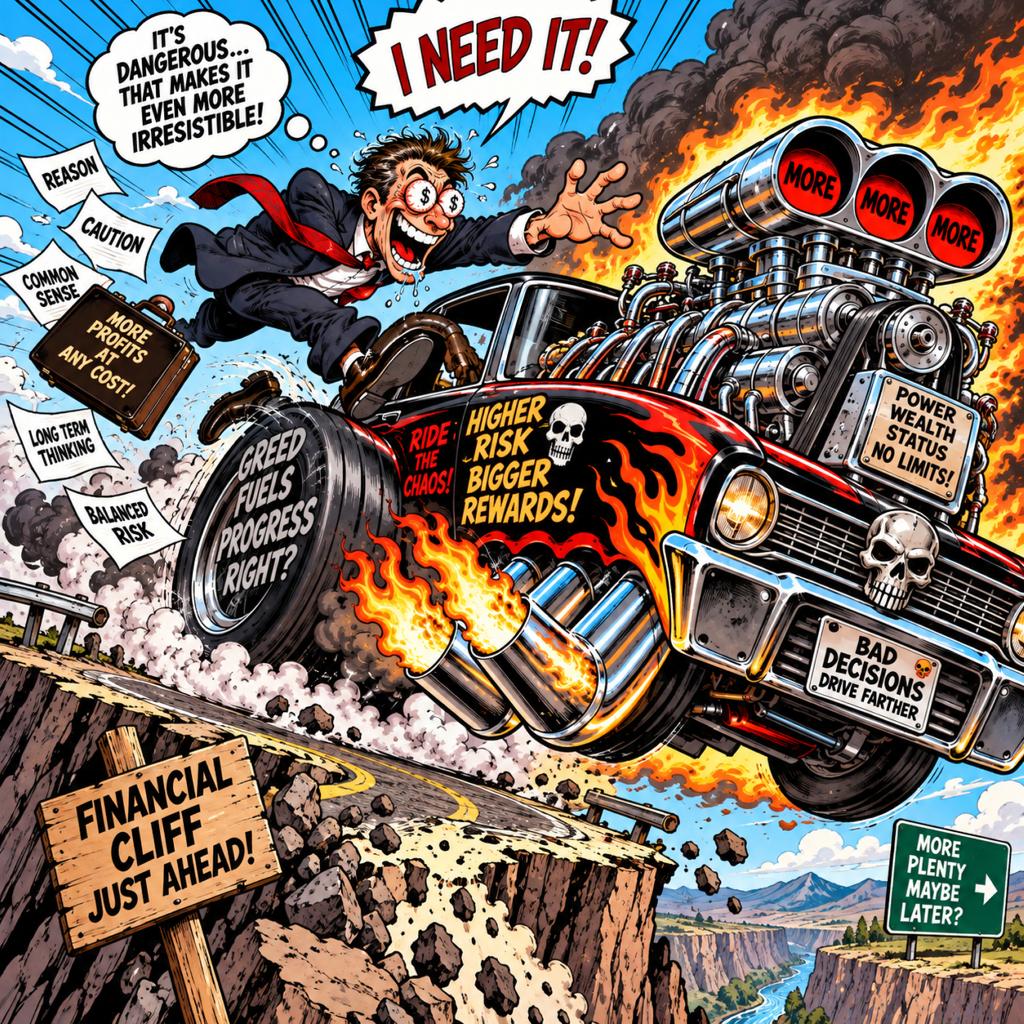
Read the message they’re selling you: “This technology is so powerful, so uncontrollable, so capable of ending the world that even we are terrified of it.” Now reread it the way a CEO would. If it’s THAT powerful, I want it. Picture a cartoon car with an oversized engine, spitting fire from its exhaust pipes, and a drooling crowd, hands outstretched, climbing over one another to get on board. No one is afraid of the car. Everyone wants the fastest one in the lot. “It could destroy the world” is not a warning: it’s a spec sheet. There’s no such thing as bad publicity, and “existential threat” is the best free advertising money can’t buy.
Catastrophe is a design choice, not a sentient decision.
Here’s the part the doom prophets skip. AI is a tool. It doesn’t wake up one morning and decide to wipe us out. Remember the movie War Games? The machine can launch the missiles only because a human being connected the missiles to the machine. Take the human out of the control loop, give the latest super-angry state-of-the-art AI model the keys, let it design its own successors with no one checking the work: congratulations, you’ve just built the risk. On purpose. It’s not the AI going crazy. It’s someone who signed off on a disastrous architecture. There is ALWAYS a human being who chose that direction. The recursive self-improvement that today (September 2026) they trumpet from the rooftops as the ultimate threat doesn’t happen by chance: someone funds it, releases it and removes the brakes.
And the resignation? It’s not the proof you think it is.
The latest departing researcher spent three years training models — first at OpenAI, then at Anthropic — gave up his unvested equity and announced it all in a thread. Noble? Maybe. But a resignation is a position, not a data point. No paper. No documented incident. No numbers. Just feelings and emotions with a label slapped on top: “danger”.
So let’s ask the honest questions and leave them open:
Did he leave for money? Probably not: he left it on the table.
Did he leave because no one would give him the power or the career he aspired to? Probably not.
But here’s the one I’d really bet on: a man who spent years studying this stuff, at the top of his field, does NOT go off to become a farmer.
Want to bet? Within a year he’s back inside a lab, or inside an institute funded by the same labs. Out the door, in through the window.
Fear sells. Expertise reads the fine print.
Stop buying the apocalypse. Start asking who’s holding the wiring diagram.
#AI #TechReality #AISafety #OpenAI #Anthropic #AIhype #Innovation #HumanInTheLoop