
The AI apocalypse is a bailout request
06/10/2026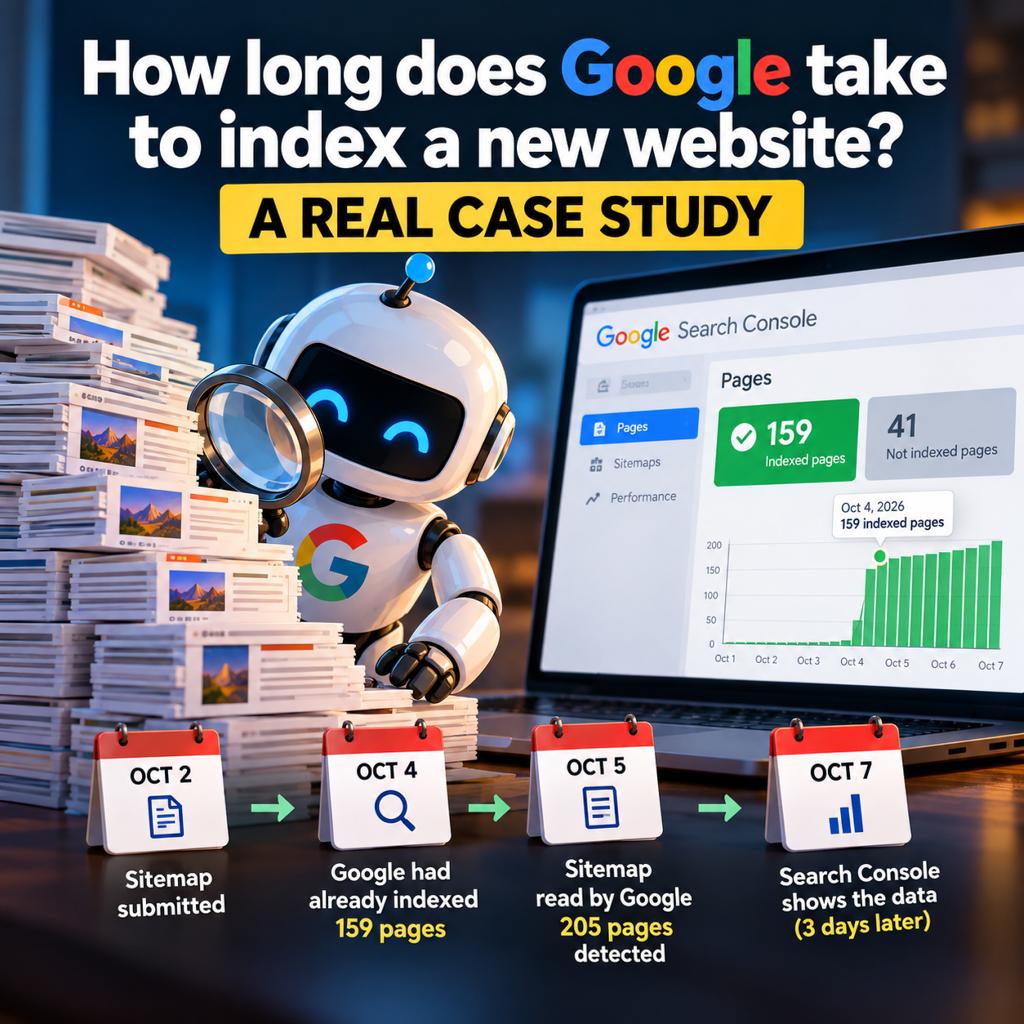
How long does Google really take to index a new website? A real case study
It is one of the most common questions when launching a new online project and, as often happens when talking about Google, the theoretical answer is simple: it depends. We are now at the end of 2026, and things have changed quite a lot.
This time, however, I do not want to talk about theory. I want to show you a real case that I was able to follow directly, with dates and data documented through Google Search Console.
This case is particularly interesting because we are not talking about the typical new website made up of three or four corporate pages. Before publication, a significant amount of work had already been done on the content, with more than 200 URLs already included in the sitemap.
The objective was quite clear: to present Google with something that already had real substance. Not to publish an almost empty shell and hope that, slowly, it would gain authority, but to present from day one a rich, structured website on which a significant amount of work had already been done.
Allow me the expression: we wanted to try to break through that wall of distrust that inevitably exists when Google encounters a new domain for the first time.
In essence, the message was: we have worked hard, we have tried to work well, now let’s see how you react.
October 2, 2026: we introduce the website to Google
On October 2, 2026, the website sitemap was submitted through Google Search Console.
The sitemap contains around 200 pages and therefore, from the very beginning, represents a website with a volume of content significantly greater than that of a typical small business website that has just been launched.
This is the original Search Console screenshot documenting the sitemap submission:
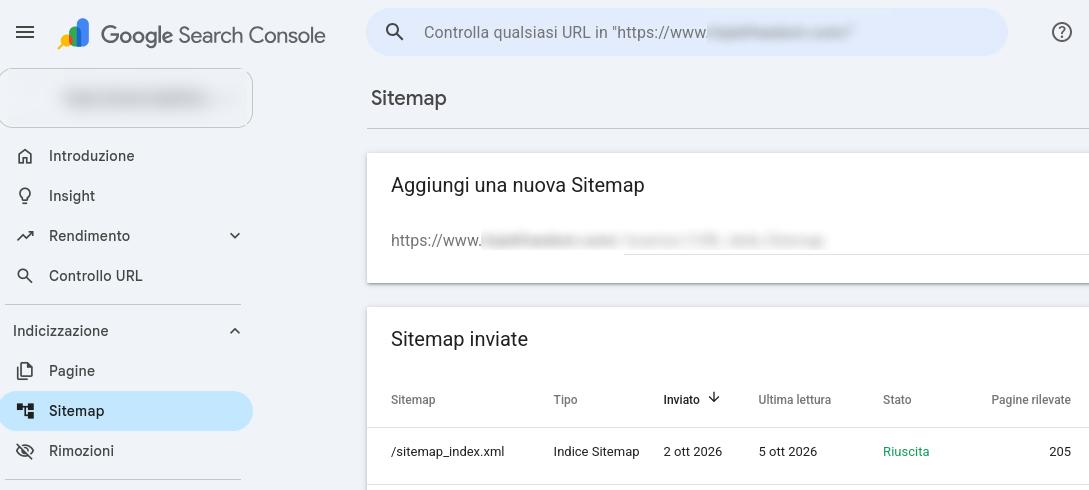
This is our starting point.
From that moment on, Google is explicitly aware of the existence of the sitemap and has the list of URLs that we want to submit for its attention.
The sitemap is read by Google
Search Console subsequently shows October 5 as the date on which the sitemap was last read. The operation is shown as successfully completed and Google recognizes 205 pages.
This information is already useful because it reminds us of something that is sometimes taken for granted: submitting a sitemap does not mean that Google will process it instantly.
But things become much more interesting when we look at the report relating to indexed pages.
By October 4, Google had already indexed most of the website
When the data finally becomes available, Search Console shows that on October 4 there were already 159 indexed pages, while 41 were not indexed.
Here is the corresponding screenshot:
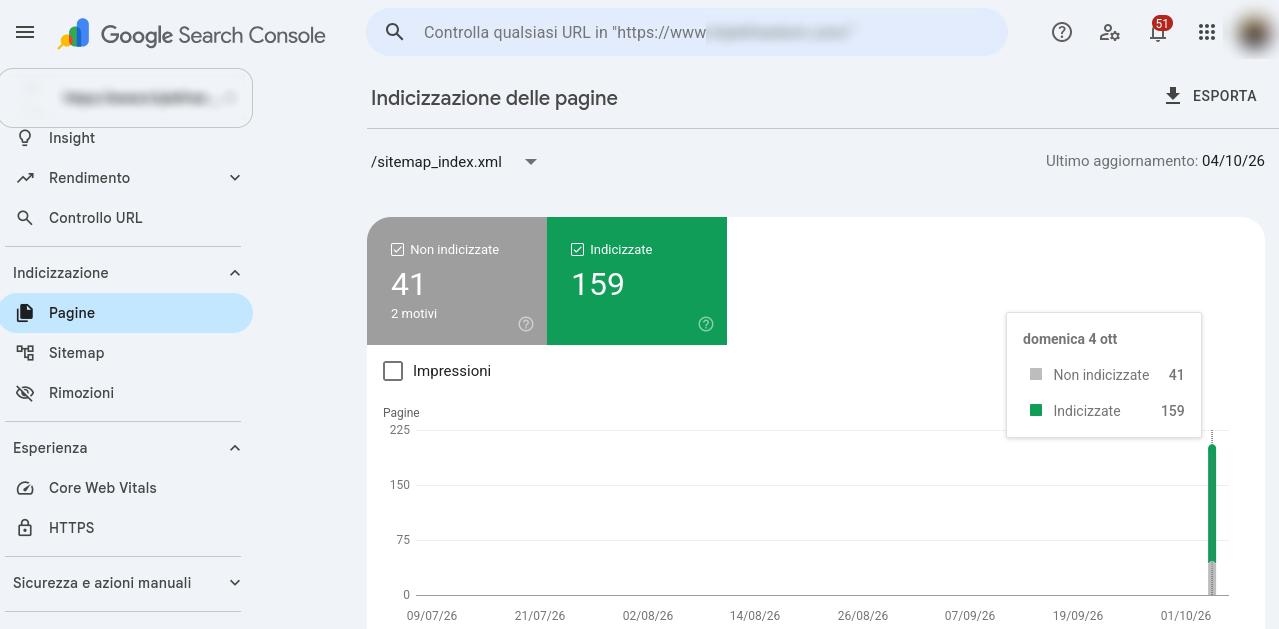
Let’s stop for a moment and look at this figure.
The sitemap had been submitted on October 2. Two days later, on October 4, Google had already indexed 159 pages.
For a completely new website with more than 200 URLs to analyze, this means that a very significant part of the crawling and indexing work had been completed in a relatively short amount of time.
If we stopped here, we could simply conclude that Google took around two days to index a large part of the new website.
But that is not the part I find most interesting.
The problem is that on October 4 we did not know it
The statistics in the “Pages” section of Search Console did not actually update on October 4.
They did not update immediately afterwards either.
The data only became visible on October 7.
In other words, on October 7 Search Console showed us that Google had already indexed 159 pages on October 4.
This distinction may appear small, but in my opinion it is fundamental.
Google Search Console is not Google
When we work with Search Console every day, we are naturally inclined to use what we see in the interface as a representation of Google’s current state.
That is understandable, but it is not necessarily correct.
This case shows very clearly that there are at least two different timeframes: the time Google needs to discover, analyze and index a page, and the time required for that information to be processed and made available in Search Console reports.
In our case, the difference is obvious.
On October 4, Google already had 159 indexed pages. We only received a clear representation of that situation on October 7.
So, if on October 5 or 6 we had looked only at the Search Console report, we could easily have concluded that Google was still behind with indexing.
In reality, what we were observing was the delay of the reporting tool, not necessarily the delay of the search engine itself.
This changes the way we should read Search Console
This is probably the most important point I want to share.
When we publish a new website, especially during the first few days, we have to be very careful not to turn the absence of data in Search Console into a diagnosis.
If the Pages report does not yet show results, we cannot automatically conclude that Google has not crawled the pages, has not processed them, or has not indexed them.
It may simply not have returned that feedback to us through Search Console yet.
And when working on a new website, that difference can be psychologically huge.
During the first few days, there is a tendency to keep checking Search Console and wondering whether something is wrong: is the sitemap correct? Robots.txt? Canonical tags? Content? Structure? Technical issues?
In some cases, those problems certainly do exist and should be investigated. But the immediate absence of data is not, by itself, proof that there is a problem.
The value of launching with a content-rich website
I was interested in this experiment for another reason as well.
I wanted to observe what would happen if we published a new website only after building a sufficiently broad content base.
Obviously, I cannot turn a single case into a universal rule, nor can I claim that a large amount of content automatically guarantees fast indexing.
What I can do, however, is observe what happened in this specific case: Google received a sitemap containing more than 200 URLs and, within around two days, 159 of them were already shown as indexed.
I consider that a significant result.
Personally, I increasingly prefer this philosophy: whenever possible, avoid presenting Google with a project that is still in an embryonic state.
A new website naturally cannot have history, established backlinks, behavioral signals or authority built up over time. What we can control from day one, however, is the quality of the work we present to Google.
Structure, content, internal links, technical correctness and the amount of genuinely useful information are all elements we can work on before Google even performs its first crawl.
In other words, we cannot force Google to trust a new website. But we can try to give it as few reasons as possible not to.
The complete timeline
To summarize the case we observed:
October 2, 2026: the sitemap of the new website is submitted to Google Search Console.
October 4, 2026: the data later displayed by Search Console already shows 159 indexed pages and 41 non-indexed pages.
October 5, 2026: Search Console records Google’s reading of the sitemap, with 205 pages detected.
October 7, 2026: the Search Console “Pages” report updates and finally makes the indexing statistics visible.
The result is therefore quite interesting: in order to see in Search Console what Google had done in around two days, we had to wait five days from the website’s initial submission.
So how long does Google take to index a new website?
After this experiment, my answer would be: probably less time than Search Console may lead us to believe.
Not always, of course. Every domain, every website and every set of content represents a different situation.
But this real case documents very clearly a phenomenon worth keeping in mind: the moment when an action takes place within Google’s systems and the moment when that action becomes visible within Search Console do not necessarily coincide.
And there can be several days between the two.
For this reason, Search Console remains an essential tool, but it should be interpreted for what it is: an analysis and reporting tool, not a real-time window into Google’s index.
The conclusion I take away from this
I take away two lessons from this case.
The first is technical: during the very first days of a website’s life, we need to give time not only to Google, but also to the tools we use to observe Google.
The second concerns the work that comes before publication.
If we want a new project to be taken seriously, I believe it makes sense, whenever possible, to present it to the search engine with a solid structure already in place and enough content to clearly explain who we are, what we cover and how deeply we are able to cover it.
There is no button that can make Google trust us.
But we can do everything possible so that, when Google arrives for the first time, it finds something worth analyzing.
In this case, it did. And, even more interestingly, it had done so several days before Search Console decided to tell us about it.