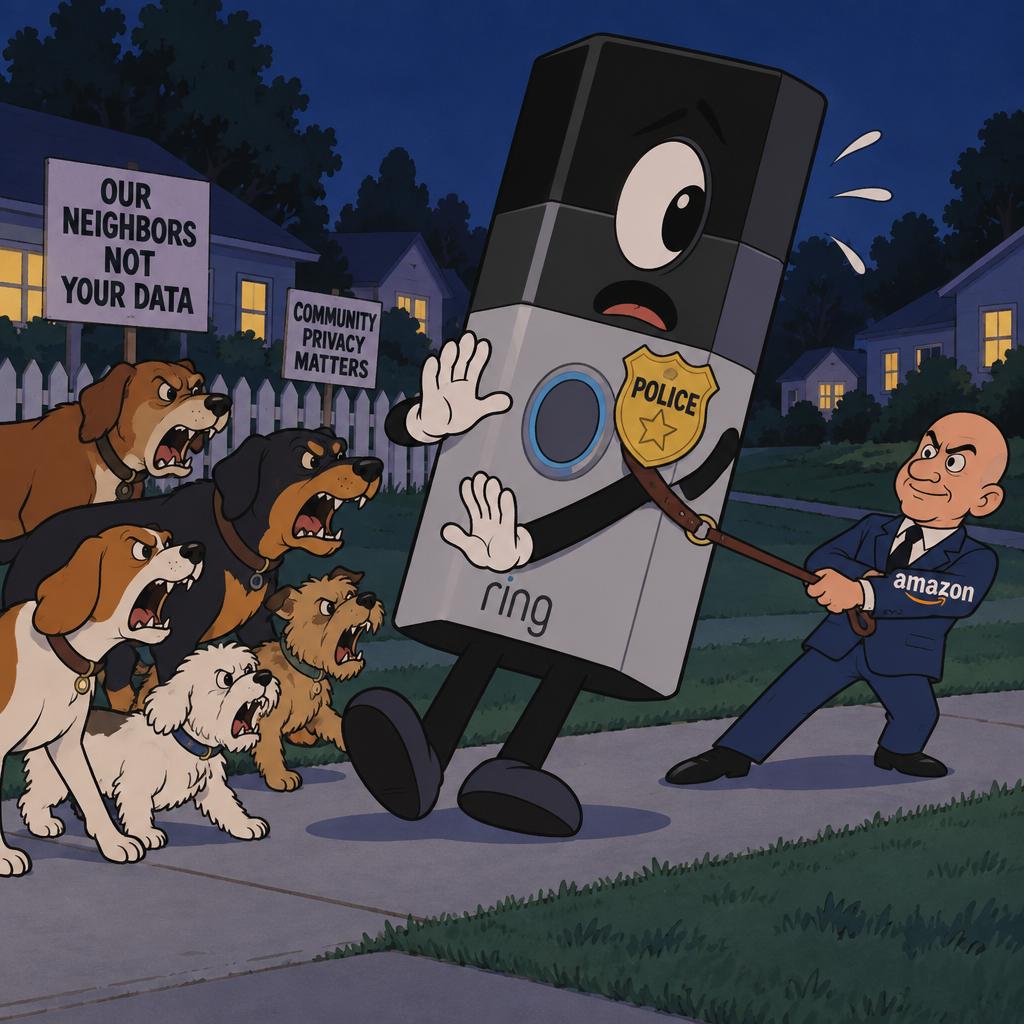
Amazon’s smart doorbell maker Ring has terminated its partnership with the police surveillance tech company Flock Safety. The announcement landed on Feb. 15, days after a 30-second Ring commercial aired during the Super Bowl in which a lost dog is found through a neighborhood network of cameras. Viewers took to social media, called it sinister, wondered aloud whether the same machinery could be pointed at humans, and said they would turn the feature off. My read is simple: this was not a review. It was a retreat — and the only question worth asking is how far back Amazon actually stepped.
The excuse is the giveaway
Ring’s statement says the planned Flock Safety integration “would require significantly more time and resources than anticipated.” It adds that the integration never launched, “so no Ring customer videos were ever sent to Flock Safety.” Flock concurs, saying it never received Ring customer videos and calling the cancellation a mutual decision that lets both companies “best serve their respective customers.” Notice what nobody says: Ring’s announcement does not cite the ad as a reason for the joint decision. Both companies reviewed, both companies agreed, and the timing — right on top of the backlash — is left for you to connect yourself. That is not candor. That is the legal department completing a sentence the marketing department started.
What was actually on the table
The two companies said last year they were planning to work together to give Ring camera owners the option to share their video footage in response to law enforcement requests made through a Ring feature known as Community Requests. That is the deal that died. Nothing else did.
Know who you were getting into bed with
Flock is one of the nation’s biggest operators of automated license-plate reading systems. Its cameras are mounted in thousands of communities across the U.S., capturing billions of photos of license plates each month. The company has faced public outcry amid the Trump administration’s aggressive immigration enforcement crackdown, though it maintains it does not partner with ICE and does not contract out with any subagency of the Department of Homeland Security for direct access to its cameras. It paused pilot programs with Customs and Border Protection and Homeland Security Investigations last year. And it makes a point that ought to end every naive conversation about this sector: Flock says it doesn’t own the data its cameras capture — its customers do. So if a police department chooses to collaborate with a federal agency like ICE, “Flock has no ability to override that decision.” Read that again, slowly. The company sells the eyes and disclaims the gaze.
The ad wasn’t even the product in question
Ring’s Search Party feature, the one in the Super Bowl spot, was not related to Flock. The company says it can “reunite lost dogs with their families and track wildfires threatening your community,” and the clip shows a dog being tracked across a neighborhood by cameras using artificial intelligence. A heartwarming dog story is how you sell a camera grid to 100 million people. The objection is not to the dog.
The pressure is bigger than one commercial
The Electronic Frontier Foundation said this week that Americans should feel unsettled over the potential loss of privacy. “Amazon Ring already integrates biometric identification, like face recognition, into its products via features like ‘Familiar Faces’ which depends on scanning the faces of those in sight of the camera and matching it against a list of pre-saved, pre-approved faces,” the Foundation wrote Tuesday. “It doesn’t take much to imagine Ring eventually combining these two features: face recognition and neighborhood searches.” Democratic Sen. Edward Markey of Massachusetts urged Amazon to discontinue Familiar Faces, writing to CEO Andrew Jassy that the backlash to the Super Bowl commercial “confirmed public opposition to Ring’s constant monitoring and invasive image recognition algorithms.”
So here is the accounting. One partnership, unlaunched, is dead. The doorbells stay on the doors. The footage stays with the customers Flock can’t overrule. The face-scanning stays in the product. Amazon didn’t quit surveillance. It quit a logo — and it did it quietly, in a statement careful enough never to mention the ad that forced its hand. The dog got home. Everything else stayed exactly where it was.