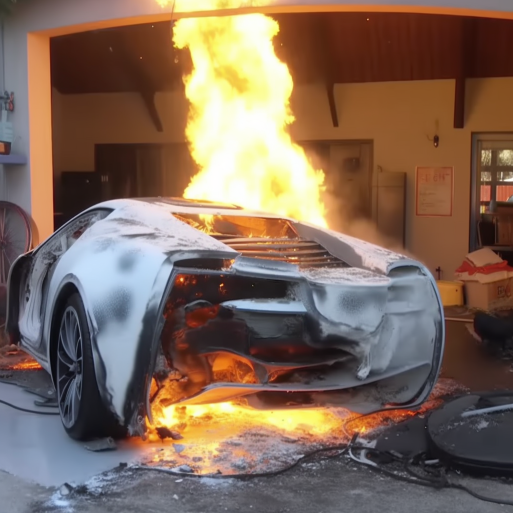
A violent fire at Vicolo 7 Aprile 1944 in Treviso caused the destruction of two vehicles, including a Renault Zoe electric car, and the garage where it was parked. The incident was triggered by a lithium battery fault in the automobile, which caused an explosion so powerful that it damaged the garage door and also involved a Mercedes Class B parked nearby. The explosion also caused a fire in a control panel located a short distance away.
Fire department crews responded quickly to the scene, managing to contain and extinguish the flames in a short time. Despite significant damage to the garage, the adjacent house suffered limited damage. Fortunately, the car owners, Giovanni Dragone and his wife Valentina Elia, remained unharmed, although they were in shock. Both are members of the Guardia di Finanza (Italian Financial Police) and have been assigned to the provincial commands in Venice and Treviso respectively. The provincial commander of the Guardia di Finanza, Francesco De Giacomo, expressed his support and wished the couple a speedy recovery during this emergency. The colleagues of the two military personnel offered their support and solidarity during this difficult time.
The authorities, including police units, launched an investigation to determine the exact causes of the explosion. The judicial police unit of the fire department intervened in the afternoon to conduct further investigations in order to dispel any doubts about the circumstances of the incident. The estimated damage caused by the explosion amounts to several tens of thousands of euros.
The incident has raised concerns about the safety of electric cars, particularly regarding the power of lithium batteries used. Electric car batteries are rated in terms of electrochemical capacity, expressed in kilowatt-hours (kWh). In the specific case of the Renault Zoe, the battery could have a capacity of between 41 kWh and 52 kWh, depending on the model and year of production. Lithium batteries can deliver a considerable amount of energy in very short periods of time, which can pose additional risks in the event of a fault or accident.
Compared to traditional energy sources such as compressed natural gas (LPG) or methane, lithium batteries present a different risk profile. While vehicles powered by LPG or methane may incur accidents related to gas leaks or explosions, lithium batteries carry specific risks related to faults or malfunctions that can lead to fires or more violent explosions.
Furthermore, in the event of a lithium battery fire, there could be
health risks associated with the exhalation of toxic chemicals. If the batteries burn, they can release harmful fumes and gases, including lithium oxides and other toxic compounds. It is essential that rescue workers and competent authorities properly manage such situations, taking the necessary precautions for the protection of public health.
In conclusion, the fire at Vicolo 7 Aprile 1944 in Treviso has raised questions about the safety of electric cars and the power of lithium batteries. It is important that adequate safety measures are implemented to prevent faults or accidents of this type and that the authorities continue to investigate to identify the exact causes of the incident. At the same time, it is essential to increase awareness and training regarding the potential risks of lithium batteries and the best way to manage them safely.